
Review · SOUTH HOLLAND
Delft – Step/scootertour in and around the city
Delft looks different from a moving step. This 1.5-hour tour gives you an unusual way to see the city, from modern building projects and Mill de Roos to old lanes and famous church towers. I like the visit to Agnetapark, a calm garden village with a good story behind it, and the stop at Hofje van Pauw, a quiet courtyard that many city walks skip. The main drawback is simple: these are non-electric steps, so you need to be comfortable riding and pushing off on your own.
The route also takes you beyond Delft’s postcard center, which gives the tour more range than a short stroll around the Markt. Guides such as Frans and Kevin have been praised for their lively storytelling and willingness to answer questions. At $32 per person, the price is fair if you value a guide, a small group, and several out-of-the-way stops, but less tempting if you only want to see Delft’s central sights at your own pace.
Six good reasons to consider this Delft step tour
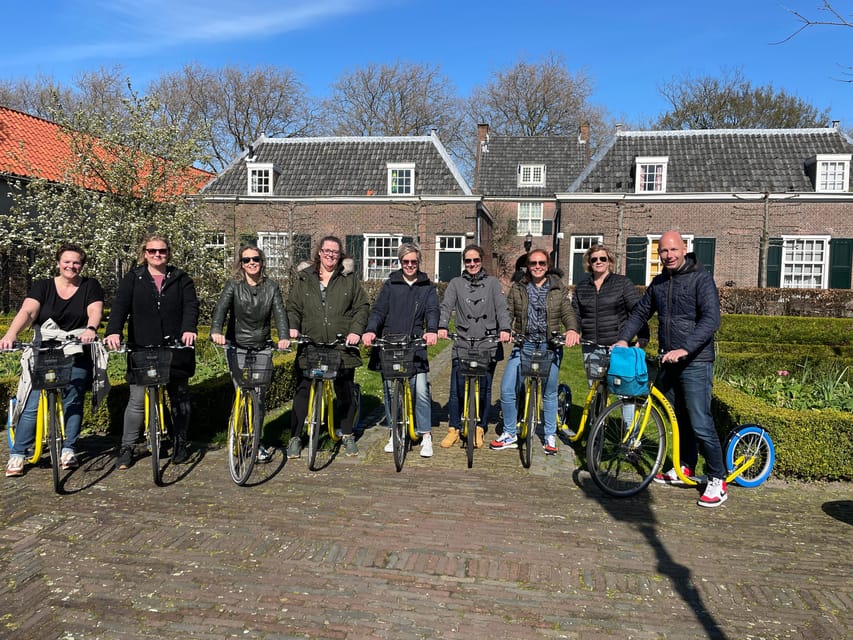
- Non-electric steps give the tour a playful pace: You cover more ground than on foot, but still move slowly enough to notice the streets and buildings.
- Agnetapark offers a different side of Delft: This peaceful garden village tells the story of Jacques van Marken and his wife, who promoted unusually forward-thinking social ideas.
- Hofje van Pauw is a quiet courtyard stop: Founded in 1707, it provides a small, atmospheric break from the city streets.
- The route reaches beyond the standard center: You see modern Delft, Mill de Roos, residential areas, the Eastern Gate, and historic streets.
- The Markt, New Church, town hall, and Old Church anchor the finale: The tour finishes with Delft’s best-known sights after showing you less familiar corners first.
- Small groups keep the tour personal: With no more than 10 participants and guides speaking English or Dutch, there is room for questions and some flexibility.
Starting at Oude Delft 113
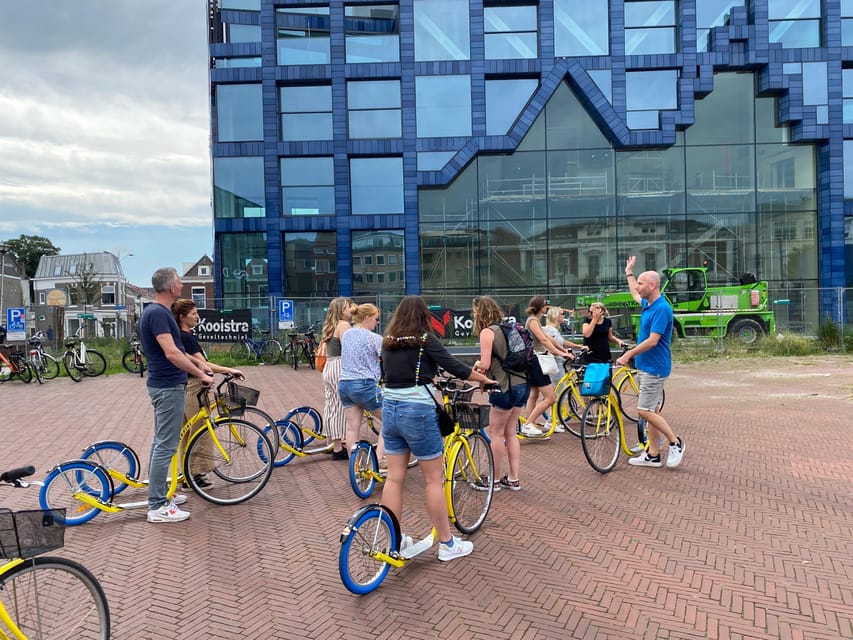
The tour begins at restaurant De Delf, at Oude Delft 113. This puts you close to Delft’s old canal-side core, but the route does not simply circle the usual sights and return. You first head toward the newer part of the city, then work through a mix of industrial, residential, and historic Delft.
That order is useful. If you begin with the Markt and the Old Church, you may spend the rest of the tour comparing everything with Delft’s familiar center. Starting with modern architecture gives you a broader sense of how the city has changed and how new building work fits beside centuries-old streets.
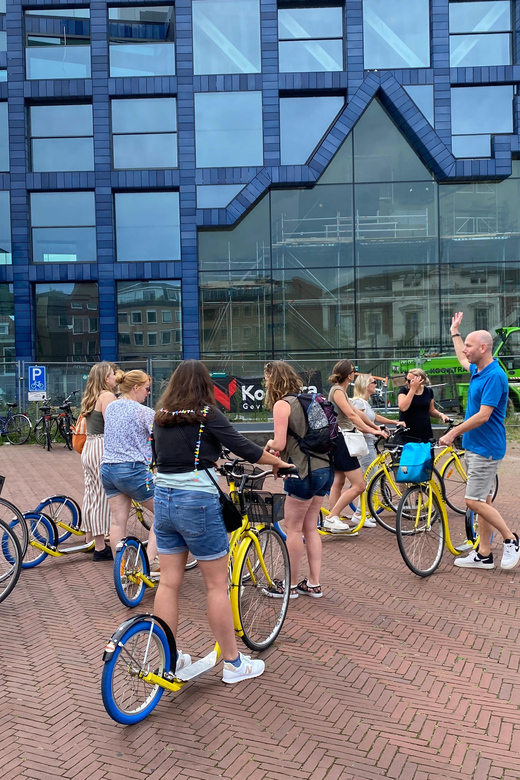
Your guide provides the steps and leads the group. The group limit is 10 people, a good size for a moving tour where everyone must hear instructions and keep together. You should expect short riding sections and frequent stops rather than a long continuous ride.
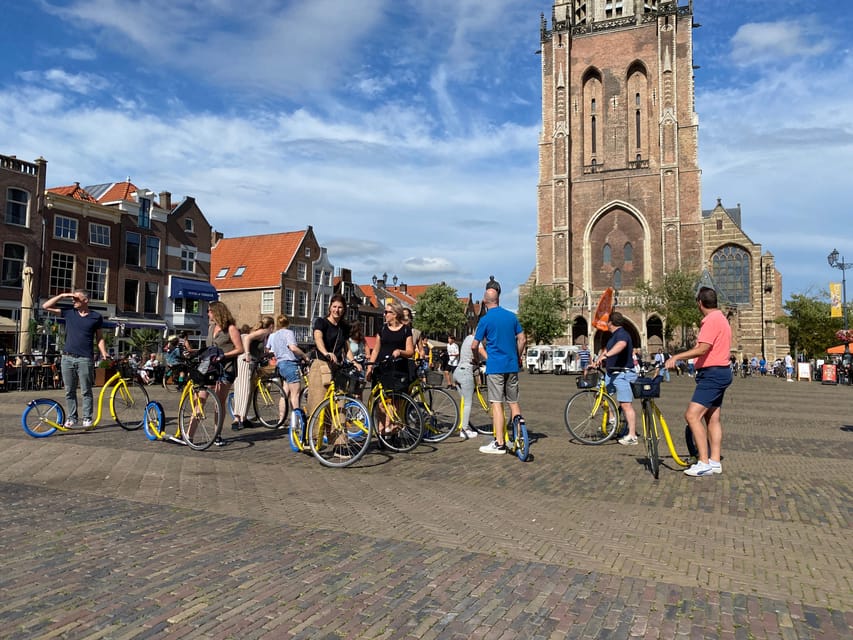
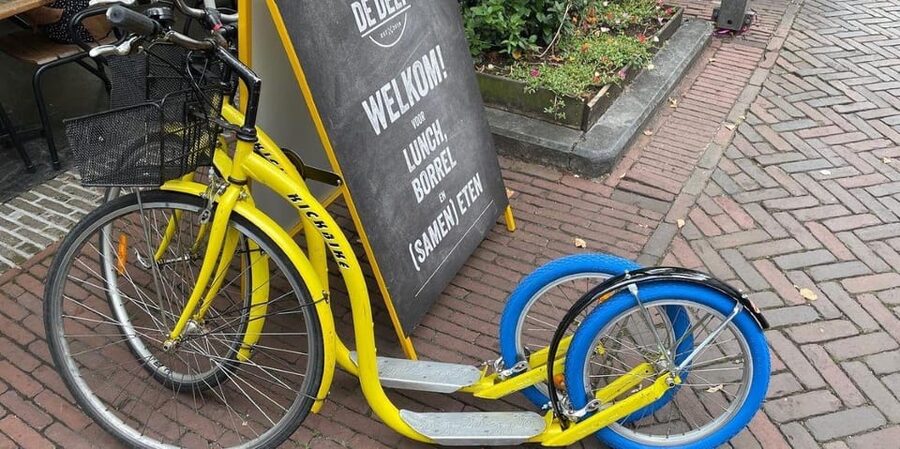
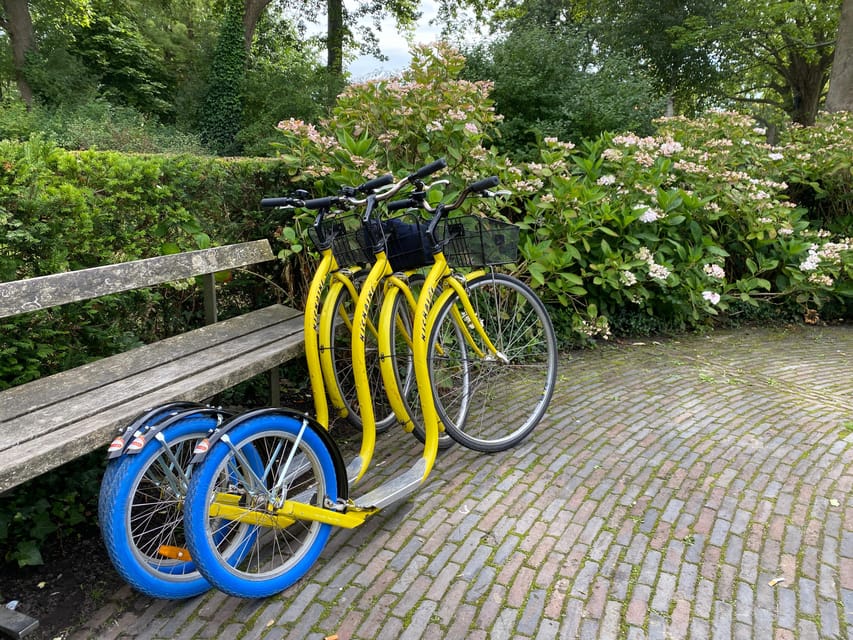
The Dutch word step means scooter in this context, but do not picture a motor scooter. These are regular, non-electric kick scooters. That distinction matters. You need to balance, push, steer, and stop yourself, and the ride may take a little getting used to. One useful advantage of the short sections is that you are not asked to ride continuously for 90 minutes.
More Scooter Tours in the world:
- Florence Vespa Tour: Tuscan Hills and Italian Cuisine
★ 5.0 · 4,019 reviews - Scooter Tours of Red Rock Canyon
★ 5.0 · 2,174 reviews - Vespa Sidecar Tour By Night with Pickup
★ 5.0 · 1,803 reviews
Modern Delft gives the route a useful opening
The first part heads into modern Delft, where the city has gained room for construction because the train now runs beneath it. The tour uses this area to point out newer architecture and city planning.
This is not the part most people picture when they think of Delft. That is precisely why it works. You get a quick look at a city that is still changing, rather than seeing only canals, blue-and-white pottery references, and old brick facades.
The modern section also helps you settle into the step. You can learn the rhythm of riding while listening to the guide, before the route moves into more historic areas. If you are not used to a non-electric scooter, this gradual start should feel more manageable than beginning on crowded old streets.
Still, do not expect an architecture tour devoted only to recent buildings. The focus remains on Delft as a whole, and the modern stop is one part of a varied route.
Mill de Roos and the working side of Delft
Mill de Roos is still in use, making it more than a picturesque backdrop. The stop gives you a look at a working piece of Delft’s past, not just a preserved structure to photograph.
A working mill adds texture to the route. It connects the city’s old economy with the ordinary business of making and processing goods. The tour does not treat Delft as a museum where every building has been frozen in time. Instead, it shows how older features can remain part of daily life.
You will have time for a photo stop and a guided explanation. The supplied schedule gives 15 minutes at each listed stop, so the visit here is likely brief but focused. That is enough for a closer look without turning the tour into a long technical lesson about mills.
If you want a full interior visit or an extended explanation of milling, this tour may not go far enough. Its strength is variety: Mill de Roos appears as one memorable chapter in a larger city story.
Agnetapark, Jacques van Marken, and a social experiment
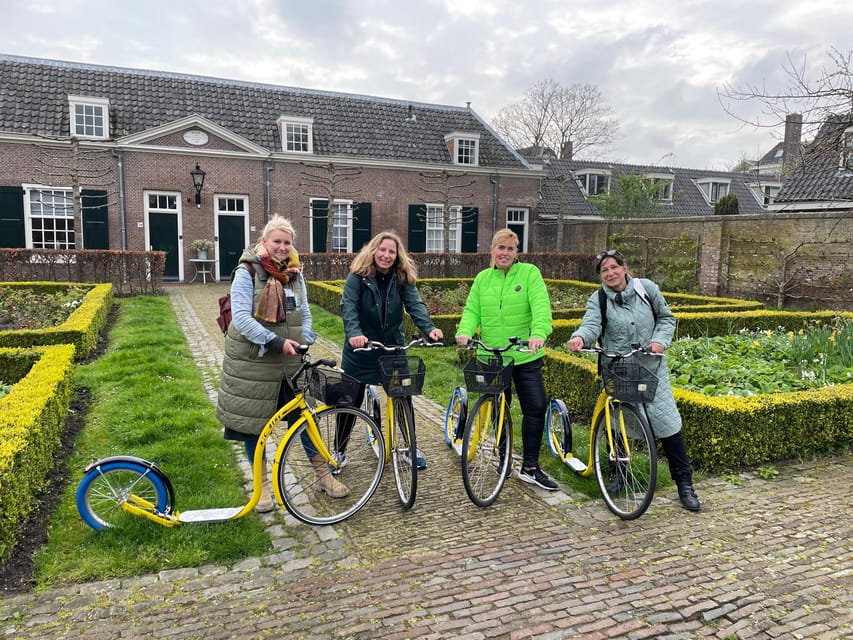
Agnetapark is one of the most interesting stops because it feels removed from the usual Delft route. It is a quiet garden village, with greenery and a calmer residential mood than the center.
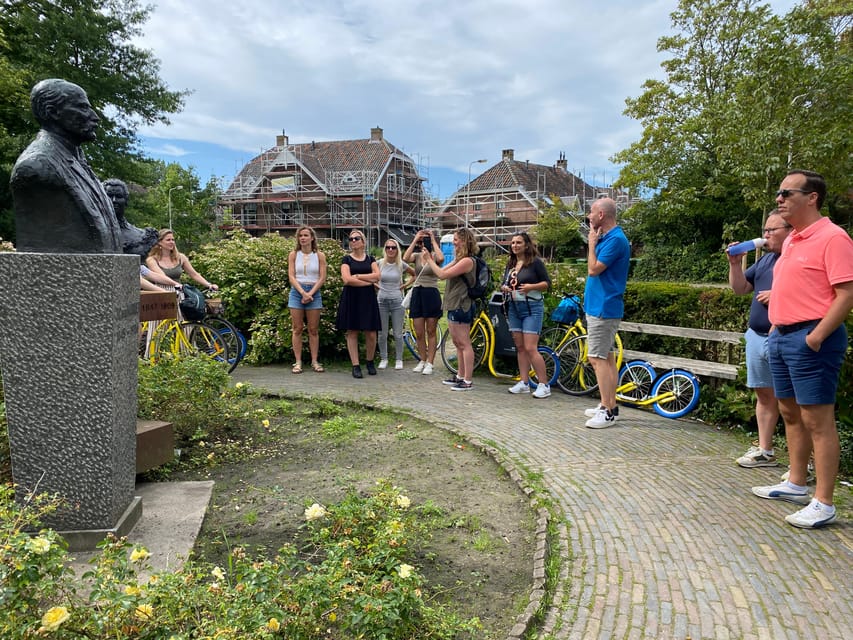
Here the guide tells the story of Jacques van Marken and his wife. Their ideas about community and social welfare were ahead of their time, and the neighborhood reflects that concern for a better living environment.
You do not need to be an architecture specialist to enjoy this stop. The value is in connecting the physical setting with the people who shaped it. A peaceful group of homes becomes easier to understand when you hear why it was created and what kind of social ideal it represented.
Agnetapark also gives the tour a welcome pause. Delft’s old center can be busy, and the step requires physical effort. A slower stop in a quiet neighborhood breaks up the ride and lets you listen without handling the scooter at the same time.
This is one of the places where a guide adds real value. Without explanation, you might pass through and see an attractive neighborhood. With the story, you get a clearer idea of why it matters.
Same streets, a different machine under you:
- Rome Morning Vespa Sidecar Tour in Rome with Cappuccino
★ 5.0 · 1,771 reviews - Budapest Small-Group Guided Tour on MonsteRoller e-Scooter
★ 5.0 · 1,517 reviews - Ho Chi Minh City: Food Tour by Scooter with Eleven Tastings
★ 5.0 · 1,502 reviews - Chianti Vespa Tour with Lunch from Florence & E-car Option
★ 5.0 · 1,453 reviews
Hofje van Pauw and the charm of a small courtyard
After Agnetapark, the tour continues to Hofje van Pauw. The courtyard dates from 1707 and is one of the route’s most appealing surprises.
A hofje is a charitable courtyard built around shared housing, usually with a quiet central space. Hofje van Pauw is described as idyllic, and that is a useful expectation to carry with you. It is not a grand monument. Its appeal comes from scale, calm, and the feeling of finding a sheltered corner within an old city.
The guide explains the woman who founded the courtyard, adding a personal story to the architecture. That detail matters because charitable courtyards are not only pretty spaces. They also reveal how people in earlier centuries tried to provide housing and support within their communities.
The stop is scheduled for about 15 minutes, enough to take photographs and hear the main story. You should not expect a long independent visit or a major museum-style presentation. The point is to notice a place you might otherwise miss.
For me, this is exactly the kind of stop that justifies taking a guided route. Delft’s famous sights are easy to locate. A small courtyard tucked away from the main flow is harder to find and easier to overlook.
The Eastern Gate and Delft’s old edges
The route includes the Eastern Gate, another photo stop that helps place Delft within its former defensive and urban boundaries. The gate is part of the city’s older fabric, and it offers a change from the courtyard atmosphere of Hofje van Pauw.
The tour does not linger at every location for a long time. You receive a short guided explanation, take photographs, and then continue. That keeps the 90-minute schedule realistic.
The sequence also shows how Delft is built from many layers. You move from modern construction to an active mill, a planned garden village, a charitable courtyard, and historic city remains. That range is more useful than spending the entire time looking at similar canal houses.
Markt, the New Church, and Delft’s grand center
The return route brings you to the Markt, Delft’s main square. This is where the city’s best-known civic and religious buildings come together: the New Church and the town hall.
The New Church is the square’s major landmark, while the town hall gives the opposite side a strong civic presence. Even if you have already seen photographs of both, the scale of the square makes more sense when you arrive after visiting quieter neighborhoods.
The guide uses this stop to point out the buildings and place them in Delft’s urban story. You have time for photographs, but this is not a ticketed interior visit. If you want to climb a tower, tour the town hall, or spend a long time inside the church, plan that separately.
The Markt stop works well near the end because it gives you the iconic Delft scene without making it the whole experience. You get the classic view, but you have also seen parts of the city that many first-time visitors miss.
The Old Church and its famous lean
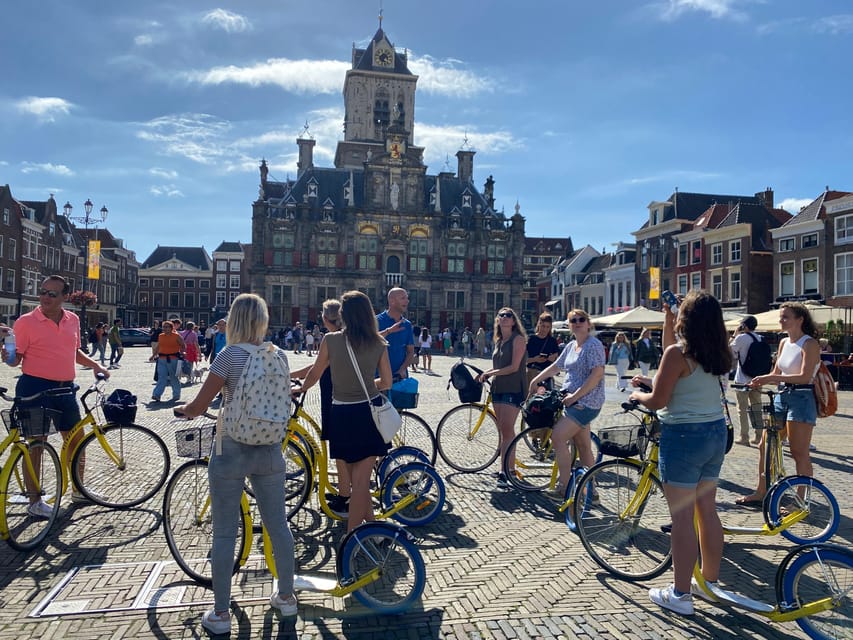
The Old Church is the final major sight before returning to the starting point. Its leaning tower is Delft’s most recognizable visual oddity, and the tilt gives the stop an instant talking point.
The building is known for leaning because the ground shifted during construction. The tour’s short stop lets you look closely and hear the basic story, while also placing the church within Delft’s old streets.
This is another photo stop rather than an extended interior visit. The schedule allows roughly 15 minutes, so you should not count on a full religious or architectural tour. That limitation is reasonable for a route covering six main points in 90 minutes.
The Old Church also makes a fitting end to the sightseeing portion. You finish with one of Delft’s strongest landmarks, then return to Oude Delft 113 rather than ending in an unfamiliar part of town.
What $32 buys you
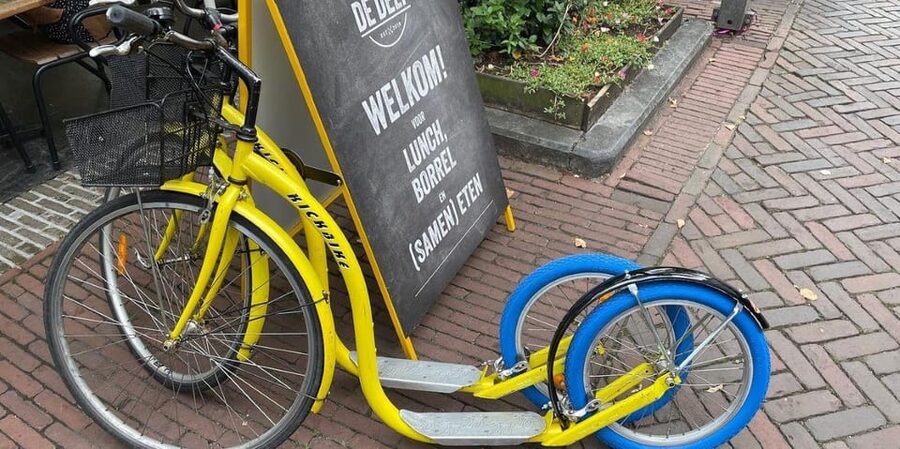
At $32 per person, the cost covers the non-electric scooter and a live guide. The value depends on how you like to see a city.
I think the price works well for someone who wants a guided introduction with more variety than a basic walking tour. You get modern Delft, Mill de Roos, Agnetapark, Hofje van Pauw, the Eastern Gate, the Markt, the New Church, the town hall, and the Old Church in a compact format. A small group also makes it easier to ask questions than on a large coach-style outing.
The drink included at the end adds a pleasant social touch. One recent tour experience also included an improvised look at places to eat later that evening, showing how a good guide can add practical local suggestions beyond the fixed route.
The price is less attractive if you already know Delft well, dislike guided pacing, or want to spend long periods inside churches and historic buildings. You are paying for movement, narration, and access to a planned route, not for entrance tickets to major attractions.
The guides make the difference
The guide is central to this experience. Frans has been praised for telling many stories in an engaging way, while Kevin has been singled out for his enthusiasm and friendly approach. You also have room for questions, and the route can include small adjustments on the way back when conditions allow.
That human element matters on a short tour. Ninety minutes is not enough to explain every period of Delft’s past, so the guide must choose useful stories and keep the pace moving. The strongest feedback points to guides who do exactly that.
The language options are English and Dutch. If you prefer a quieter, self-guided visit, this format may feel too structured. If you enjoy hearing the reason behind a building or neighborhood, the live commentary is likely the main reason to book.
Who will enjoy the ride, and who should skip it
This tour suits adults and older teenagers who can ride a bicycle and feel comfortable trying a non-electric step. It is a good match for first-time visitors who want a broad look at Delft, including places outside the usual center.
It also suits people who prefer short bursts of activity. The route includes riding, stopping, listening, photographing, and riding again. You do not need to spend 90 minutes walking, but you do need enough balance and mobility to use the scooter.
The tour is not suitable for children under 16, wheelchair users, visually impaired people, or anyone who cannot ride a bike. The steps are not electric, so you should not book this expecting motor assistance.
Warm weather may also affect your comfort. A summer ride on a non-electric step can feel tiring, especially with repeated pushing. Wear practical clothing and shoes, and treat the frequent stops as part of the design rather than a sign that the route lacks momentum.
Practical details before you book
The experience lasts 1.5 hours and is limited to 10 participants. It is offered in English and Dutch, and the meeting point is restaurant De Delf at Oude Delft 113.
You can cancel up to 24 hours before the start for a full refund. You can also reserve now and pay later, which helps if your Delft plans are still shifting.
I would arrive ready to ride rather than dressed for a formal city walk. The supplied steps are non-electric, and the operator advises looking at the photographs so you know what kind of scooter to expect.
The route includes short guided stops of about 15 minutes at Delft, Agnetapark, Hofje van Pauw, the Eastern Gate, the Markt, and the Old Church. The exact balance between riding and explanation can vary with the group and guide, but the design is clearly a compact circuit rather than an all-day outing.
Should you book this Delft tour?
Book it if you want to see Delft beyond the standard canal-and-square route, enjoy a little physical activity, and like local stories attached to ordinary-looking places. Agnetapark and Hofje van Pauw are the strongest reasons to go, while the Markt and Old Church supply the classic landmarks.
Skip it if you need an electric scooter, cannot ride a bicycle, or want long interior visits. At $32, it is a good-value introduction for first-time visitors who want a friendly guide and a small group, especially if Frans or Kevin is leading the tour. The best way to think of it is as a lively city sampler: broad, social, and pleasantly different from a standard walk.
FAQ
Where does the Delft step tour start?
It starts at restaurant De Delf, at Oude Delft 113.
How long does the tour last?
The tour lasts 1.5 hours.
What kind of scooter is provided?
The scooter is a non-electric step, which means you push it yourself rather than using a motor.
Is the tour offered in English?
Yes. Live guiding is available in English and Dutch.
How large is the group?
The group is limited to 10 participants.
Which Delft sights are included?
The route includes modern Delft, Mill de Roos, Agnetapark, Hofje van Pauw, the Eastern Gate, the Markt, the New Church, the town hall, and the Old Church.
Is the Old Church included?
Yes. The Old Church is a scheduled photo and guided stop, with attention to its leaning tower.
Who cannot take this tour?
The tour is not suitable for children under 16, people who cannot ride a bike, wheelchair users, or visually impaired people.
Can I cancel if my plans change?
Yes. You can cancel up to 24 hours in advance for a full refund. You can also reserve now and pay later.
Just added around the world
- Electric Scooter Tour: Full Tour (Old Town + Ostrów Tumski)★ 5.0 · 3 reviews
- Vespa Tour with Professional Photographer★ 4.9 · 9 reviews
- Vespa – Wine and Photography service in Rome★ 5.0 · 32 reviews
- Visit Hossegor on an all-terrain electric scooter – with a guide★ 4.7 · 4 reviews
- Rome: Vespa Tour with Gelato and Photos★ 4.9 · 7 reviews
- Vespa tour with Professional Photoshoot★ 4.8 · 22 reviews
- Vespa Voyage: Scenic Routes of Rome★ 5.0 · 41 reviews
- Vespa Tour – Explore Ancient Rome★ 5.0 · 5 reviews
Netherlands Scooter Tours, compared.
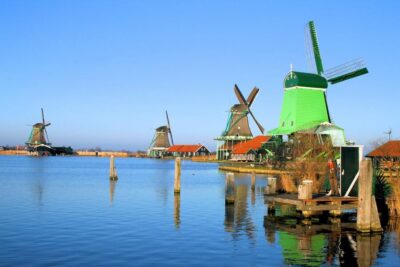
Zaanse Schans: Windmills, Clogs & Cheese by Electric Scooter
Read our review →
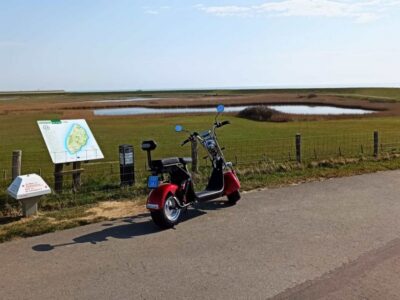
E-scooter rental Volendam – Countryside of Amsterdam
Read our review →
Texel: Explore Texel with a Café Cruiser E-scooter
Read our review →
Browse the lists this tour appears in